Tuesday, June 21, 2011

Saying Goodbye to Ginger

Things haven't been working out so well with Ginger2.  She's sweet and friendly, and she's been great company for Tori.  But every time we take her out to lunge or ride, she ends up limping.
A 20+ mare, on high fat, high fiber (a pricey feed), and not suitable for even the little boys to ride.  We decided to replace her with a more suitable horse.
I bought Knightmare last week, kind of on a whim.  She's settled right in.  Her hooves need work before we even think about riding her, so we haven't done anything but lunge her.  The farrier should be here this week.

At the moment we have no idea whether she'll be a better match for us than Ginger or not, but we figured we had nothing to lose by sending Ginger off to auction yesterday.  At minimum, Knightmare will make a fine companion horse, and we've no need for two of those.
So there she goes.  Goodbye Ginger.  Good luck.

The Turkey Pen

They start out so little...
But they grow fast!

At three weeks old, these little guys were pretty much into trouble all the time!

Their pen was coming though!
Posts went in and the frame came together.
Plastic on the roof.  The door went on.  Then the walls.  Orange snow fence up over the plastic on top.  The plastic can come down once the weather warms up, then they'll have lots of ventilation.
The fencing went on around the pen, and finally, the gate.

The turkeys were glad to be out of their brooder box.   Goose moved in to work as a guard.  He's been fighting with Rooster over in the chicken pen, so it's good for him to have his own brood here to watch over.

They're all happy to be out eating leaves and bugs and running around.
Growing extremely well.  Almost too big to escape the pen and break into the greenhouse now.
The little trouble makers ate the broccoli in the greenhouse, and laid on the brussel sprouts.  The brussel sprouts are recovering, but the broccoli had to be replaced.

So if you wondered how I could raise them, love them, and then eat them- there you have it.  They ate my vegetables, now I have to eat them.

Thursday, June 16, 2011

Day Three

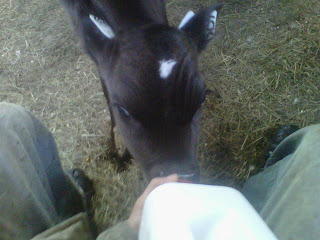
Still going strong. Toothless is a lively little calf. We've been feeding him 1.5L every 3 hours. Today we're bumping it to 2L. He's very hungry all the time- which is good- but I think he's a little too hungry.

His poops are a bit too dry as well. He's not drinking any water yet, and it's been hot here. The extra water will do him good.

We built a proper gate for the turkey pen yesterday. I feel much more comfortable having a calf in there now.
Sent on the TELUS Mobility network with BlackBerry

Tuesday, June 14, 2011

Questions- Bottle Calves

 On my post New Arrivals, PP asked

"Thanks. I have never found beef for as cheap as you figure it. How soon will he be weaned?"

My reply got a little long winded, so I thought I'd start a new post instead.

No, you can't judge the price of beef by my figures here.  This is just this one calf, a by-product of the dairy industry.  Cheap to buy.  Some people, like me, buy them and raise them for personal use.  Most go to slaughter between birth and three months, depending on their weight. 

Beef calves stay with their mothers at least 6 months.  Then it depends on the farmer.  Some people separate them when the mothers are rebred.  Some separate them before the new calves are born.  Some live in the same pasture- bulls, cows, and calves of all ages - until they go to market.  The mothers will wean this year's calves before next year's calves are born.

A beef calf is the end product.  So from birth they have a higher value.  The farmer has invested the past year into breeding the cow, maintaining her health, feeding her, rotating pastures, fencing, etc, to develop a healthy calf.  He's worth more in terms of labour, as well as the quality of meat he will eventually become.

Dairy farms breed to keep the cow in milk.  Milk is the end product.  The calves are taken from their mothers within a day or two.  Heifer calves may be kept or sold to replace stock.  Bull calves are a by-product.  They're cheap because they aren't wanted.  They're in the way.  Their bone structure is different than a beef calf.  Longer legs, slimmer hips and chest.  They'll never get as big, and supposedly, they won't taste the same.  They're bottle fed until they'll eat grain. 

One bag of milk replacer is supposed to be enough to get three calves to weaning.

We weaned Nelly after two bags of milk replacer, at about 4 months old.  She didn't like the grains.  She started eating grass at about three weeks.  Calves have weird multi stomachs.  They need to develop good bacteria in all of them to process their feed.  One stomach will overflow into the next, which will make them sick if the bacteria haven't developed yet.

We fed Nelly all the time.  Every three hours at first, and gradually fed her more at a time, less often.  We didn't follow the directions on the bag, nor the methods used by most in the industry.  Milk replacer is not designed like human formula.  It's designed to bulk up those by-product calves for slaughter, not to raise them into adulthood.  It's not designed to grow those good bacteria and develop the stomachs.  The calves are no longer considered veal once they start eating grass.  So we played with it, and we got Nelly through the process.  We'll attempt the same method with Toothless.  I expect to use two bags of formula, but it will depend entirely on his development, when he starts grazing, how much grass he eats, how much water he drinks, when he seems ready to lose the bottle.

Who's who?

She arrived around 8 last night. It was uneventful. Tori normally runs around kicking and bucking when someone new arrives. Not this time.

Ginger stood back and watched as the chestnut twins calmly circled each other. It was more like we walked in with a big mirror than a new horse.

Welcome to the pasture, Knightmare.
Sent on the TELUS Mobility network with BlackBerry

Monday, June 13, 2011

New Arrivals

We went to the auction today.  The plan was for geese and ducklings, but we were late getting started and completely missed the small stuff.  But did I come home empty handed?  No, of course not.  I took the boys with me.  The younger three.  #1 is still in school.  But three is enough.

There was a horse there.
A lovely little chestnut mare. 
A little thin.  Not too old.  Friendly.
She could very nearly be Tori's twin.  Right down to the lopsided mane.
And, just like Tori, when I leaned my head through the gate, she dropped her head to mine and nuzzled up against me.  You know that's a sign of pure evil.  That's a horse's way of saying, 'Oh, you're a big softie.  Take me home so I can drive you insane every time you even think about riding me, eat you out of house and home, and not even give you the time of day unless you bring me treats'.  Or at least that's been my experience.  Maybe I'm just a poor judge of character.

At any rate, when she came up for sale it was me versus the meat buyer.  She should be here some time tonight.  Let the Knightmare begin.

Then there was this odd looking little calf.  My sale slip claims he's a holstein.  I don't think he's a pure bred, but who knows.
He's more brown than black, with only a couple of white spots.  His umbilical cord is quite dry, so I'm guessing a couple days old at least.  We brought him home in the car and moved him in with the turkeys. Stopped on the way for a bag of milk replacer.  He's living with the turkeys for now, to keep him quarantined from the other cows.


$45 worth of beef.  $60 for milk replacer.  With a little luck and some patience, it should be well worth the investment.  I haven't decided between Evil Kneivel and Toothless.  Toothless is from the movie 'How To Train Your Dragon', as is Knightmare, so fits the theme for this year.  His personality so far though, is screaming out Evil Kneivel.  We had to chase him down and corner him to feed him his first bottle.

I needed something to do while #1 & #2 were at camp...  lol

Saturday, June 11, 2011

Rubarb

We had a small patch of rhubarb in the raspberry patch when we moved in, and a big patch just behind the house.  The big patch was too close to the weeping tiles, got trampled repeatedly when we moved the horses across the yard, and way too close to where we planned to put the wood shed.

The first summer I split a chunk off and moved it to the garden.  It's still alive, but hasn't done well in the dry sandy soil.  The second year I split some more off and moved it to the front yard - the flower bed.  It did better than the garden patch, but it still seemed too dry.  Last year I took out the rest before #2 built the wood shed.  I moved it into the trees behind the garage - the beginning of the forest garden.  It takes longer for the frost to leave the ground in the woods, so early in the spring when I would normally see the first shoots of rhubarb there was nothing.  I am happy to say that it did survive, and is taking to it's new home beautifully now.
 And maybe it"s our wonky cold/hot/cold/hot weather this year, but the earlier transplants are all starting to kick it into high gear this year as well.  I probably won't cut much off of any of them this year, I want them to be well established.  But next year, oh boy, I will feast indeed!

Rhubarb is a wonderful perennial weed.  It's cold hardy, easy to grow, and prolific.  Buy a little stalk (or ask a neighbour for a chunk of root), dig a little hole, and ignore it.  What could be simpler?  If your new to gardening or self sufficiency, rhubarb has got to be one of the easiest places to start.

When I was a little girl, Granny would serve as fresh, raw rhubarb with a bowl of sugar for dipping.  Probably not one of the healthiest snacks we could have had, but every spring as I bite into that first sour stalk, it brings back fond memories.

My favourite rhubarb recipe is rhubarb bread.  It's a winter staple around here.  A great, nutritious, quick and easy breakfast.  Raspberry rhubarb pie disappears quick, and rhubarb sauce makes a great dessert.


Freezing rhubarb is practically effortless.  Wash, chop, bag, seal, freeze.  It tends to fall apart as it defrosts, which actually makes it easier to work with later.

Rhubarb Sauce
  • 1 cup mushy rhubarb (from freezer, or cooked)
  • 1/3 cup melted butter
  • 1 cup sugar
  • 2 eggs, beaten
  • 1 teaspoon baking soda
  • 1 teaspoon baking powder
  • 1 teaspoon salt
  • 2 cups of flour

Preheat the oven to 350°F (175°C).  Mix butter, eggs and rhubarb in mixing bowl. Add sugar, baking soda, baking powder and salt and mix in. Add the flour, mix. Pour mixture into a buttered 4x8 inch loaf pan. Bake for 1 hour. Cool on a rack. Remove from pan and slice to serve.

 This recipe can easily be tripled, and freezes nicely.


Raspberry Rhubarb Pie

I mix a jar of raspberry sauce with about 2 cups of diced rhubarb into an unbaked pie shell.  Cover with another pie shell, and vent.  Bake at 425°F for 15 minutes.  Reduce to 350°F, continue baking for 40 minutes or until golden brown.  

Rhubarb Sauce

Wash and dice 2 cups of rhubarb.  Cook in a sauce pan with a bit of water, squirt of molasses, and 1/2 cup sugar.